
Lead generation works well—until it doesn’t.
For businesses operating in highly specialized segments, standard lead generation tools quickly reach their limits. Broad databases, generic filters, and mass outreach strategies are designed for volume, not precision.
In niche industries, this creates a fundamental problem:
You are not looking for more leads.
You are looking for the right ones.
This is exactly the challenge we addressed with the development of AQUNAMA AiLead.
The Problem with Conventional Lead Generation
Most tools operate on the same principle:
- large datasets
- keyword-based filtering
- generalized targeting
This approach works in high-volume markets.
It fails in specialized environments such as industrial manufacturing, technical supply chains, or engineered products—where:
- customer profiles are highly specific
- buying processes are complex
- decision-makers are difficult to identify
The result is predictable:
Low-quality leads, wasted outreach, and inefficient sales processes.
From Tools to Systems
Instead of trying to optimize existing tools, we approached the problem differently.
We designed a system.
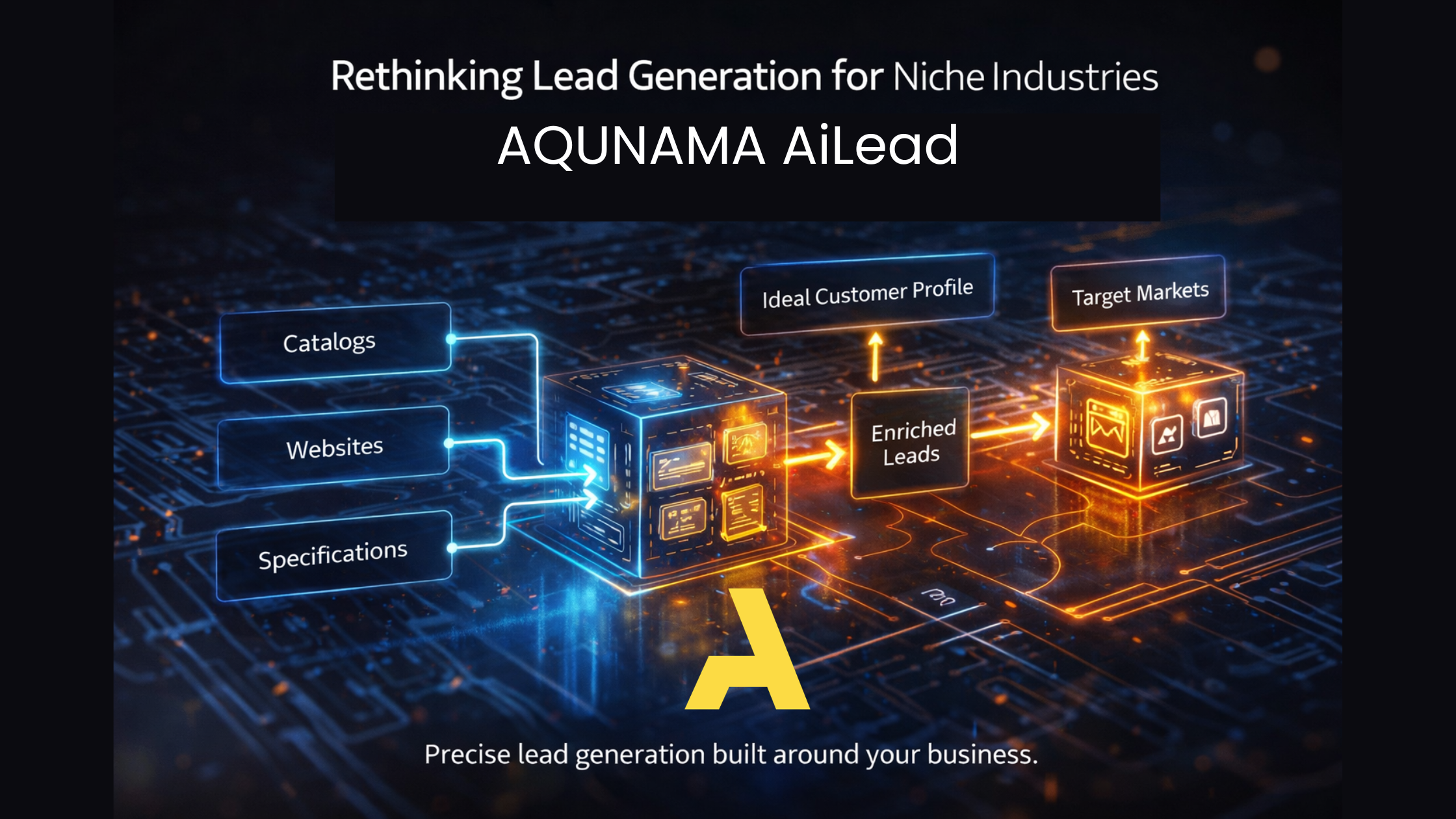
AQUNAMA AiLead is not a database or scraping tool.
It is a structured lead generation system built around your actual business context.
How AQUNAMA AiLead Works
The system is built in layers, each designed to eliminate guesswork and increase relevance.
1. Business Context Ingestion
The system first processes your internal data:
- product catalogues
- technical specifications
- website content
- positioning and use cases
This step ensures the system understands what you are actually selling—not just keywords, but context.
2. Ideal Customer Profile Definition
Next, we define the Ideal Customer Profile (ICP):
- industry segments
- application areas
- company characteristics
- decision-making roles
This replaces generic targeting with structured precision.
3. Market Selection
You then define the markets you want to explore:
- geographic regions
- industry clusters
- strategic expansion areas
This allows controlled and intentional lead generation, instead of broad, unfocused outreach.
4. Lead Generation and Enrichment
Based on the defined parameters, the system generates leads and enriches them with relevant data:
- company details
- contact structures
- contextual relevance to your offering
This significantly increases the quality and usability of each lead.
5. Automated Outreach
The final layer is execution.
AQUNAMA AiLead integrates with outreach channels such as:
and runs structured communication sequences aligned with your positioning.
No mass messaging.
No random outreach.
Each interaction is grounded in relevance.
Practical Application: Industrial Actuators
One of the first deployments of AQUNAMA AiLead was for a client operating in the industrial actuator space.
In this segment:
- potential buyers are highly specific
- applications vary significantly across industries
- standard lead generation tools produced mostly irrelevant results
By implementing AiLead:
- lead quality improved significantly
- outreach became targeted and structured
- sales teams focused only on relevant opportunities
This is the difference between searching for leads—and building a system that produces them.
Beyond Lead Generation
AQUNAMA AiLead reflects a broader principle:
AI should not be used to optimize inefficient processes.
It should be used to redesign them.
In this case, the shift is clear:
From generic lead generation → to structured, context-driven systems.
When This Approach Makes Sense
AQUNAMA AiLead is particularly effective for businesses that:
- operate in niche or technical markets
- struggle with low-quality leads
- require precise targeting rather than volume
- want to integrate lead generation directly into their operations
Conclusion
Lead generation is not a data problem.
It is a system design problem.
When the system is built correctly, relevance replaces volume—and sales teams can focus on what actually matters.
If you are operating in a niche segment and facing limitations with conventional tools, it may be time to rethink the approach.
Get in touch to explore how this system can be applied to your business.

